- 10. September 2019
- -
- Attica Care
- -
- Angebote Attica Care
- -
- Kommentare deaktiviert für Attica50
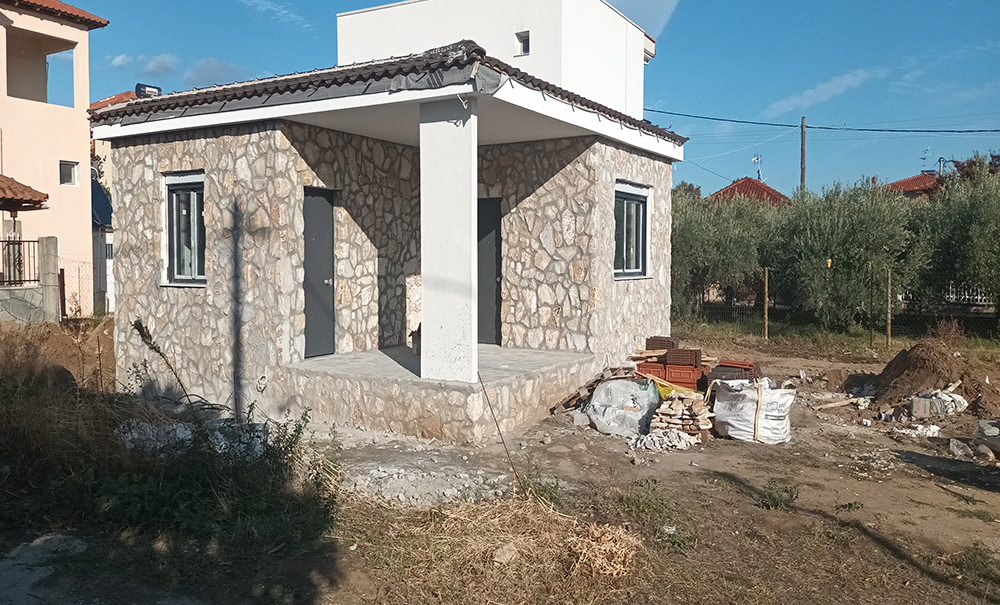
We offer Attica50 barrier-free prefabricated bungalow throughout Greece
Barrier-free, disabled-friendly, age-appropriate and senior-friendly living in your own prefabricated house. This house design is not ours. We could build something similar for you as an A+ class passive house. We always offer our houses on a turnkey basis and equip them with basic furniture, kitchen and electrical appliances, as well as a heat pump and a solar heating system (Twin-Solar products) from Grammer Solar Amberg, Germany. We only plan and work with brand-name products/elements that meet the certification requirements of the Greek Passive House Institute.
This is how your Attica50 bungalow is created. We plan the following process: A) Personal consultation at our premises or at your home to draw up your requirements profile. B) Planning of the house. Review of building regulations/energy technologies and property analysis including site plan & soil survey or soil conditions. C) Project planning or house planning consists of many small and large details, such as the economic assessment that influences the project. The new energy laws are an important part of the planning process. D) Approval phase and processing. In cooperation with our architect or civil engineer, we prepare all the necessary documents for the building application so that all you have to do is sign them.

We offer several modern bungalow designs. The surroundings, the location of the plot and accessibility are important for your project. The energy choice for the bungalow is an extremely important decision. We advise you based on your financial possibilities so that you can make the best decision.
E) Earthworks. Earthworks prepare the site for the shell construction and foundations. The soil is excavated down to the load-bearing layer in accordance with the soil survey. The building structure is marked out on the building plot in accordance with the site plan. The excavated soil from the foundations is stored on the side of the plot, as is the topsoil.
F) The floor slab is concreted. A responsible specialist tradesman is always present on site for all work up to the pouring of the concrete.
G) Traditional, proven three-layer masonry. When it comes to an outer shell with particularly high weather protection, we like to fall back on traditional, proven three-layer masonry walls. Due to the durability of these façades and low maintenance requirements, tried-and-tested three-layer masonry pays off very well in the long run.
H) Roof truss. The roof truss must always be erected very carefully and, above all, properly, as there are structural requirements to be met. Erecting a roof truss requires a high level of expertise and a great deal of experience. As standard, we work with 24 cm thick insulation in this area.
I) Roof covering and roof edge finishes. The upper edge of every pitched roof, where the sloping roof surfaces meet, is called the ridge. This transition is specially protected with the aid of special elements, e.g. ridge tiles or stones, and in the case of metal roofs, individually folded profiles. The main function of the ridge covering is to ventilate the roof and protect it from moisture penetration. The eaves form the opposite end to the ridge. They are the lower edge of a sloping roof surface and also act as the drip edge of the roof when it rains. This is why the roof drainage system is attached to the eaves. The side edges of sloping roof surfaces are called verge boards. Similar to the ridge, special products provide additional protection for the roof structure and create a harmonious finish across the roof edge.
J) Interior construction. Installing partition walls in flats or houses is not particularly difficult, but the noise protection and insulation properties of drywall alone are often not very good. That is why we use aerated concrete blocks for interior construction, which have excellent thermal insulation properties and are also reasonably soundproof.
K) Facade construction. Clinker-faced facades combine classic looks with energy efficiency and durability. Because our builders today have to pay more and more attention to energy efficiency when constructing houses, they often opt for clinker-faced facades. Six out of seven builders opt for a brick-built house. The energy required for heating can be significantly reduced by using a double-shell wall construction with a facing brick wall – the double outer wall protects the house from the cold in winter and from excessive heat in summer.
L) Window and door elements. Windows are the thinnest points in the outer shell of a house. In addition to heat and cold, this is also where unwanted visitors can most easily gain access. Therefore, in addition to the technical properties of thermal insulation, burglary protection is also an important feature. Thermal insulation in and around windows are the loopholes for interior heat. Leaky or technically outdated windows allow most of the expensively generated room temperature to escape. Conversely, solar radiation in summer can cause undesirably high temperatures indoors. The installation of modern, thermally insulated windows is the right measure to combat both problems. When building a new house, the insulating effect of the windows is calculated precisely in order to maintain a pleasant indoor climate and save energy costs.
M) Roof overhang and plumbing work. A roof overhang not only beautifies a house, it also protects the façade. Many weather influences such as rain or hail are thus kept away from the exterior wall, at least in part. In order to use a weather-resistant and durable material, we generally use high-quality PVC profile cladding for the roof overhang. The plumbing work also includes the installation of all rainwater drainage systems, such as gutters or valleys.
N) Underfloor heating with a high-quality studded membrane system. The structure of the underfloor heating is important for comfort and efficiency. In new buildings, hot water underfloor heating is generally installed using a wet system. In a wet system, the heating pipes are laid in the screed, which must cover the heating pipes by at least 45 mm. The structure and combination of the insulation layers depend on the load on the top floor and the relevant DIN standards and regulations. In the studded system, the flexible and easy-to-install heating pipe is simply pressed into the sturdy foam-filled pipe holders of the studded polystyrene hard foam panel with your foot. The studded panel is applied to an impact sound insulation panel, which contributes to sound insulation,
fire protection and moisture protection.
O) Plastering work. Plasters are wall coverings made of plaster mortar for decorating interior walls. Interior plasters are applied to ceiling or wall surfaces in interior rooms and consist of one or more layers of plaster of varying thicknesses. Plasters primarily fulfil structural and, of course, aesthetic functions.
P) Electrical installation. When it comes to installing electrical systems in your home, our builders have very different requirements. In order to provide you with the best possible service, our master electrician will go through the shell of the building with you and discuss each individual room. Every builder has their own individual ideas about the installation of electrical systems, which means that very personalised planning and implementation is required. Thanks to our master electrician’s many years of experience in new construction, meeting your quality requirements is part of our everyday routine. Q) Heating and solar heating system from Twin-Solar. Choosing the right heating system for a new build is not easy: there are many systems to choose from. We provide you with an overview of the legal requirements and the appropriate heating technologies. There are many ways to heat a house, but not all of them are up to date. In recent years, we have intensively studied and specialised in renewable energies and their effects, and can show you the new process technologies in many new buildings on site.
